Writing a Book Report — Your Complete Guide


Book reports are summaries and analyses of books written by students. These reports typically include key details: the protagonists and antagonists, the setting, plot points, personal reflections, character analysis, and more. Book reports are most often assigned in elementary and middle schools, but they can also be found in high school and certain college courses. Depending on the assignment or grade level, a book report can be anywhere from 100 to 500 words long.
Why You Need a Structured Book Report Template
A structured book report template is a useful tool for expressing thoughts about the book you've read. It helps you save time, develop critical thinking skills, and prepare a report that will earn an A+.
Key features of a good report template:
- Proper structure. Depending on your grade level and whether the book is fiction or non-fiction, book report structures can vary. A ready-made template standardizes everything, making it easier to organize and express your thoughts clearly.
- Easier to grade. Teachers evaluate not only your ideas but also the report's structure. A standardized format saves them time when grading each submission. With a template, it’s immediately clear who has thoroughly read the book.
- Easier to start writing. When you have a blank page in front of you, it’s always difficult to write those first few sentences. With a layout that includes fields for notes, you don’t need to waste time on formatting and transitions.
Overall, a printable book report template is a highly useful tool, which can also save up to 40% of your time without compromising the quality of the report. Now, let’s look at what should be included in your report so you can get the highest grade.
Essential Elements of a High-Quality Book Report
How to write a book report outline: A simple plot summary won't be enough; it's important to show an in-depth analysis of the work and a thorough understanding of the material. To achieve this, there is a standard layout consisting of six key elements that work for almost any book report format.
The Basics (Header Information)
The basic information about the book should be included in the header. The reader of your report should immediately understand which book you are analyzing. Include:
- The full title (including any subtitles).
- The author's name (you can briefly mention any awards they have won).
- The genre.
- The publication date.
You can format this directly in the header section using the first few lines.
Setting and Context
Next is a description of the world the work immerses you in. This provides the foundation for the entire story:
- The time period in which the events take place.
- The location, which could be a specific city, a house, or an entire fictional planet.
- Your impressions of the atmosphere.
You can also briefly mention any events that influence the characters and their actions.
Character Analysis
No story is complete without characters who develop, change, and grow as the plot unfolds. This is the heart of the book. In your report, it's important to include not only names but also how the characters change.
This section should include:
- Information about the protagonist: their goals, strengths, and weaknesses.
- Information about the antagonist: they don't necessarily have to be a person; it could be nature, circumstances, or inner demons.
- The character’s arc: did they grow as a person or, on the contrary, fail?
- Supporting characters who played a key role in the plot.
Understanding a character's motivations and choices is perhaps the most important part of reading a book. Don't forget to mention those who helped them and how they influenced the plot.
Plot Summary
A plot summary is a brief overview of what happened in the story, but you don't need to delve too deeply.
It's enough to highlight:
- Introduction: The event that starts the action.
- Rising Action: The main obstacles the characters face.
- Climax: The turning point of the story.
- Resolution: How the main conflict is settled.
Don't write too much here. The more concisely you highlight the main events, the better your report will be.
Themes and Symbols
Your literary analysis should also point out:
- The main themes explored by the author.
- Symbols that carry hidden meanings.
- The main takeaway you want the reader to have.
This is a key part of getting a high grade, even though it can be subjective. You can show your own perspective.
Personal Evaluation & Conclusion
Your personal thesis statement is a must-have. Share your thoughts and the reasons behind them:
- What you liked or disliked about the book.
- Who would enjoy this writing style and why the topic matters.
- How you would rate the book on a scale of 1 to 10.
These six key sections will ensure your book report is one of the best. There's nothing complicated about it, especially when you have a clear structure.
Fiction vs. Non-Fiction Book Report
Yes, there is a slight difference when comparing a fiction book report with a non-fiction one. It’s not just about the subject of the book, but rather the questions you ask when reading.
The main differences between fiction and non-fiction book reports:
- In fiction, you should focus more on themes, character analysis, and understanding the author's intended message.
- In non-fiction, you should look for the main thesis and analyze the author's arguments and the practical value of the information.
In short, focus more on the “Symbolism” section when writing a fiction book report and avoid it altogether for non-fiction. Instead, the “Personal Evaluation” section (where you discuss how useful the book was) is the most important.
Step-by-Step: How to Create Your Own Template
You now know what your report should include and which key points to focus on.
Now, here is a step-by-step plan on how to do your book report:
- Start reading the book; pay close attention to the plot, characters, and their motivations.
- Take notes as you read on anything you consider important for plot and character development.
- Create a rough outline based on your notes; this is the best stage to start using a template.
- Draft all six main sections of your report using the notes you’ve gathered.
- Review and proofread each section to ensure you haven't missed any important details.
Understanding the structure and purpose of a book report makes it much easier to write a high-quality paper. And do you know how to simplify the process even more? Use the fillable book report templates from TheGoodocs.
Skip the Manual Setup With Ready-Made Book Report Templates
If struggling with formatting isn’t your thing, TheGoodocs has a great solution. We've prepared a dedicated category of unique book report templates suitable for different grade levels and genres. Our site features a variety of editable and printable forms that can be filled out via Google Docs and Word. You can also convert them to PDF and print them out to fill in by hand.
Featured Book Report Templates
Student-Friendly Book Report Template - a versatile option suitable for any grade and genre.
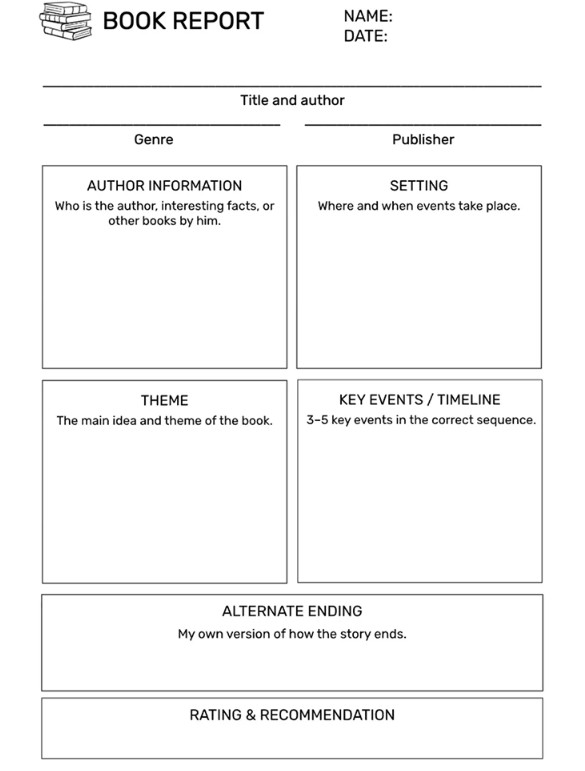
 Edit Free Book Report
Basic Book Report Template - suitable for both elementary and middle school students.
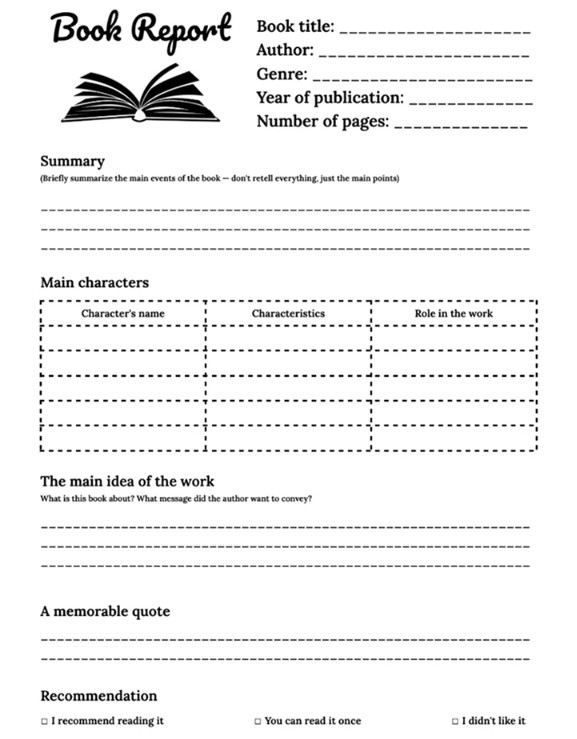 Edit Free Book Report
Printable 4th Grade Book Report Template - the perfect solution for writing book reports in elementary school.
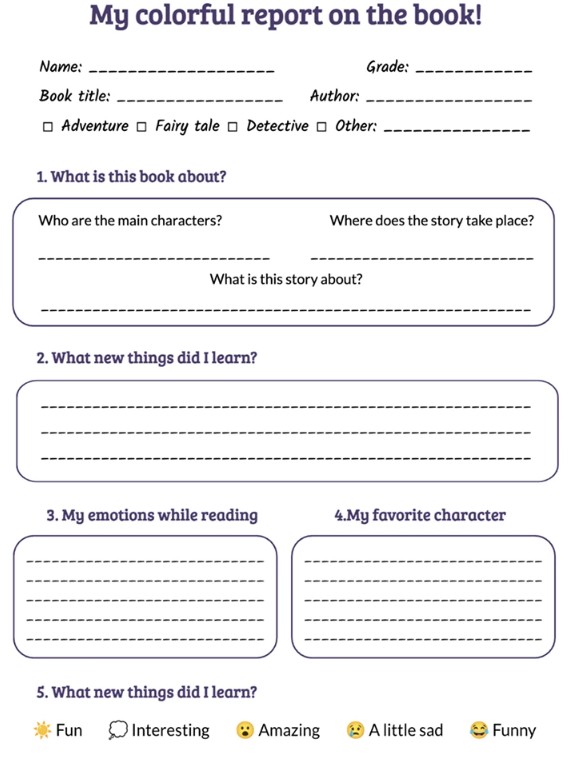 Edit Free Book Report
Conclusion & Pro-Tips for an A+ Book Report
The structure described in our article will definitely help you create a book report that your teacher will appreciate. However, it's important to know not only what to include in the template, but also how to write it.
Therefore, we've prepared our top 3 tips to help you write the best report:
- Don't waste time retelling the plot. Your teacher has already read the book; what matters most to them is an explanation of why the events unfolded the way they did and your personal reflection on what you've read.
- Focus on more than just appearance. There's no need to describe what a character looks like. The key is their inner world and their evolution as the plot unfolds. What were they like at the beginning versus the end? What happened to make them change, or why did they stay the same?
- Use direct quotes. Quotes are the "evidence" for your analysis. But be careful! Don't rewrite a whole paragraph; one or two sentences will suffice to prove your point.
Writing a book report can be much easier than you think. By using a structured template and focusing on these key points, you'll be able to write a more in-depth analysis and move logically from topic to topic. Use our tips and templates, follow the structure, and you’ll have an A+ in your pocket!

We are a team of creative people who dream of sharing knowledge and making your work and study easier. Our team of professional designers prepares unique free templates. We create handy template descriptions for you to help you choose the most suitable one. On our blog, you'll find step-by-step tutorials on how to use Google Products. And our YouTube channel will show you all the ins and outs of Google products with examples.